Wednesday, August 5, 2015

The Proverbial "Before"

Last week, I made the decision to finally see a doctor about the feelings of depression I've been suffering from all my life but which have intensified and become nearly overwhelming. It was not an easy decision to come to and I practically had to force myself to dial the numbers to make the appointment. You can read about my feelings regarding this decision here. In the week that followed between the call and the appointment itself, there were moments of such relief at the impending change that I was brought to tears thinking of how I would explain what I've been feeling and how the doctor might help. My hopes were encouraged by friends and family who told me about their experience treating their depression, and hearing the ease of the process. There was a light at the end of this tunnel of despair.

And there were also moments of clarity, when it became so very clear that I needed this help that I had set out to get. A neighbor's cookout left me grappling with such intense social anxiety. It felt like a rash under my skin, just this slight discomfort, and all I wanted was to leave and curl up on the couch with a book. I wondered if medication would change my homebody-introverted self, but I found that doubtful. What I hoped was that it would cure that itchiness. It shouldn't hurt to be around people. There was no cause for the discomfort; my presence was practically unnoticed, and when I was engaged, the conversation was cordial. Still, I left early, leaving my friendly husband behind to socialize. He couldn't understand my discomfort (and likely resented my rudeness at just ghosting). We argued when he got home because I wanted him to come home with me so we could spend time together, but I failed to communicate that effectively, and he was left feeling controlled. "Why should you wanting to leave trump my wanting to stay?" Why indeed, I considered, and finally decided, "Because I am uncomfortable. My discomfort should trump your indifference to staying." He hadn't realized the intensity of my anxiety. And it's hard to understand when there is no cause for it. Our neighbor's are perfectly welcoming people with kind friends, and they are fun to be around. Overcome by my feelings, I sobbed. "I am a burden," I thought. "I'm saddling him with my issues and making everyone else think I'm a bitch." I locked myself in the dark bathroom, sat on the edge of the tub and sank into the darkness of my mind as I choked on my sobs. "This is why you're going to the doctor," I saw. When I got a hold of myself, I apologized to my husband for making my problems his. "I'm sick," I said. "I don't want to feel like this. But I can't do this alone." He held me and said he's there for me and he loves me and supports me and he's sorry for not understanding. And I cried at my good luck of finding someone so good to me. 

This will forever be known as the proverbial "Before". Before I Got Help. Before I Went On Prozac. 

Here's to feeling better.
When I arrived to work late after my doctor's appointment, my boss kindly asked, "Is everything okay?" With a sense of relief, I replied, "Yes, everything is fine. And it's going to be better. Got me some Prozac." A self-described narcissist, he asked, "It's not because of me, is it? It's not work?" I had to laugh. "I've just always been like this. And I'm tired of it." I have lived for nearly 30 years with depression. The despair, the listlessness, the nihilism, the weight, the ruminating, the self-defeating thoughts. I don't know who I am without these feelings. But I am ready to find out.

I have been on Prozac for almost a week now. I literally feel lighter, like a weight has been lifted from my shoulders. I feel like the dark cloud above me has moved on. I laugh easily at things that a week ago would have made me grin at best. I actually feel joy in a way that is hard to describe, but which I never really felt Before, when at its worst, joy was sometimes tinged with pain, and always clouded with that familiar heaviness.

I'm still me. I haven't lost my creativity, that darkness that fuels my writing -- a fear that I had previously used as an excuse for not seeking treatment, and then finally decided was a risk I was willing to take. I am still lazy, and will wait until the last possible second to do something -- even now I should be cleaning my house. But now there isn't that heaviness pressing down on me, stopping me from doing the things I need to do. Before I couldn't even make myself clean up the house or go to the store or go visit with the neighbors. Now I am simply able to do it. I am able to find the motivation. Things that would wear on me throughout the day Before, dragging me down, simply don't anymore. We've gone over to the neighbors and played Cards Against Humanity and had a lot of fun. 

There were side-effects. Crushing headaches the first three days, and some nausea, but the headaches have passed, thankfully. The nausea only comes now if I take the pill on an empty stomach, and even then it is very mild. My sleep has changed, but I haven't decided if it's for the better or worse. I have more vivid, memorable dreams, but it's harder to wake myself up. What I mean is: Before, I would be wide awake in the morning but not feel motivated to get out of bed, because "What's the point?"; whereas now, I wake up groggy and want to snooze my alarm. But maybe that will pass. 

My doctor gave me a questionnaire to determine the strength of my depression and anxiety -- the PHQ-9 and the GAD7. The last question is "How difficult have these problems made it for you to do your work, take care of things at home, or get along with other people?" For me, it has been extremely difficult. It should not be this difficult to live your life, you know? I'm not a doctor but if you take the questionnaire and find you have moderate to severe depression or anxiety, please do yourself a favor and tell your doctor about your feelings now, don't wait. It doesn't make you weak to ask for help. It shows your strength to have dealt with it alone for so long and your courage for standing up to your depression and fighting back. There is no prize, no reward for the person who suffers the longest. Get help now. I only wish I had talked to my doctor about my depression sooner. 

Thursday, July 23, 2015

Teach me how to "Self-Care"

I didn't grow up in the kind of family where, if you got a cut or a cold, you went straight to the doctor. Slap a Band-Aid on that boo-boo and call it done. If you can imagine the opposite of a helicopter mom, that's my family.

I haven't been to a proper doctor since my last school physical. I do my annual visit for women's healthcare, and I tell myself that it's for the health of my breasts and my cervix, but it's really just so I can get birth control. At my last annual exam, my Pap smear came back with abnormal cells and I was told I have a strain of HPV that could cause cancer. I was scheduled to come back in six months for another exam. After battling with the hospital billing due to some confusion over changing insurance plans, I was reluctant to return. And then, a sudden promotion for my husband moved us out of state before that appointment rolled around. I would need to find a new doctor. But that's not really why I didn't go back. In truth, I was scared. And it seems like a giant waste of money to be told my cells are still abnormal and I just have to wait to see if they turn into cancer or if it goes away on its own. So six months past and I didn't go and then another six months and I still didn't go and I knew that eventually my prescription for birth control would run out and I would have to go for that reason alone. But then CVS Caremark, remarkable service that it is, simply asked my former doctor to renew my prescription for me, and they did.

But I'm not writing to talk about women's healthcare. I'm writing to talk about self-care – this buzzword in the mental health world. And it's something I was never really taught. See my family suffers from mental health issues, but our solution isn't really to take care of it, at least not for our own sake. My mother says she has to take Lexapro in order to be nice to others. She'd probably never admit it and would hate for me to be telling strangers this. She hates the fact that she has to take it at all and sometimes she doesn't take it. I try to avoid her during those times. She doesn't take the Lexapro to feel better, she takes it to act better. But I don't want to act better, I don't want to feel like this. The few times that I've suggested that I have mental health issues, or any health issues really, she dismisses my notions. Maybe she wants to believe that I am a perfectly healthy, normal daughter. But I am her daughter. And her insistence to dismiss these notions in her attempt to make me feel better serves only to invalidate my feelings and, essentially, gaslight me. She told me that everyone feels like that sometimes and that it's reasonable, that it's my job getting to me, that it's my introversion – all reasons that I've used myself to justify not getting help.

And it's not just her. My husband, head full of right wing conspiracy theories from the internet, warned me not to tell the doctors that I have a gun. But the conversation twisted and turned and devolved into a warning that "they" will come take our guns someday. Maybe they should, I said, because maybe I shouldn't have them. Indignant, he replied that they're his guns too. The implication: That my recieving mental health care would cause him to get his guns taken. Now I'm not sure who needs help more, me or him. I kid, of course, but behind this conversation lies the heart of the mental health stigma. If I get help, if I go on anti-depressants, I'll be on a list somewhere and people might know and what if it prevents me from being able to do something in the future and what will people think if they find out. 

But I have a bigger, more important question: What if I actually start feeling better? 


I booked a doctor's appointment for a general check-up for the first time in my life. I don't really know the proper way to do this, to ask for help dealing with these feelings of depression and anxiety, but I figure this is a good first step. And though I really want someone to hold my hand and call the doctors for me and tell me, "You're doing a good thing, you need this, and I'm here to help and guide you through it," I understand I'm on my own. I always have been. I'm scared and nervous and lost. But if I can put aside my protective, secretive nature and open up to this doctor, maybe I can open the door to a future free from this black dog. 

(Hey, maybe you can help me find the courage — if you've been there, walk me through it. I hate walking into something not knowing how it's going to go. Let me know I'm not alone.) 

(Also, don't worry, I'll book a Pap while I'm there.)


Friday, April 17, 2015

A Different Kind of Crazy

Yesterday was April 16th and around the world, people struggling with depression and thoughts of suicide drew semi-colons on their wrists in a display of strength. We will beat this, they said. We won't let our story end. 

A semi-colon is used when an author could have ended a sentence, but didn't. Pause, it says; but keep going. 

White ink tattoo, to match my scars. #semicolonproject416
Mental illness runs in my family. I've seen how it tears at a person's emotions and leaves them feeling like they are not quite themselves. I've seen how medication helps, or doesn't. How it makes a person feel numb, empty. Or how medication lulls them into a sense of security, and then leads them to believe because they are better they no longer need it, and then they stop taking it and everything falls apart again until they start taking it again. Repeat ad nauseam. Or how, when the right person finds the right medication and the right dosage, it works exactly as intended and helps maintain balance, normalcy. 

I've never taken medication for my depression. Honestly, I'm scared to. Afraid of how it will make me feel. Afraid of getting the wrong medication, the wrong dosage and feeling (more) suicidal, maybe going through with it, or maybe just going back to self-harming like I did when I was a teenager. I've been able to suppress my depression with cognitive behavior therapy. Though I've never seen a therapist. (My mother's admonition, though I am now an adult with my own healthcare plan, runs through my head: "We can't afford that, Kate.") 

I've seen the way emotions flood through a person, and all logic and rationality leave their bodies like steam from a kettle. I know how it feels to want to control everything, everyone and the frustration of not being able to. I've felt the possessiveness, the jealousy. That was me, once upon a time. But not anymore.

"I won't ever behave like that," I tell myself. The lashing out, the paranoia, the inflated self-importance. The criticism. The angry disappointment when someone lets you down, despite the insanely high expectations you had. It's not me, I say. "Oh, you have it too. Or you will," my brother warns me with a teasing smile. And I worry I do. But I won't. "My kind of crazy is different," I tell him. 

People can't let me down, because I expect nothing of them. I will never feel the inflated self-importance because I cannot see myself as important. The paranoia will never overcome me because nothing is really about me, not really, not ever. And that's okay. I don't need it to be. Our world is but a lonely pale blue speck in the great enveloping cosmic dark, and I am exponentially smaller. The things people say or do are not reflections of me or my self-worth; they are reflections of themselves. 

I'd like to believe myself incapable of the sort of sharp criticism that cuts another person down. I know the pain words can cause. The back-handed compliments that cause a young girl to feel ashamed of her body. Intended as a statement of jealousy, envy. Me, enviable? No, they must be mistaken. They must mean there is something wrong with me because I am different. I don't want to stick out, I don't want the attention. "Blend in, blend in." But no, that's not right either because I don't want to be the same. "Be unique, be you." But who am I? I am but a reflection of my environment. I am not Me in that environment. So I run away. 


There's a picture of me from high school graduation, parents flanking me with proud smiles. They see an accomplished young lady, beautiful, with her whole life ahead of her. She is not Me. When I look at that picture, I see something entirely different. My smile is unconfident, my eyes sad. My white blouse clings to me too tightly, revealing too much cleavage and I'm underweight, unhealthy. I'd lost 25 pounds in two weeks that year because of depression -- anxiety caused my stomach to churn at every meal I sat down to, food was unappealing -- and I was struggling to fight the urge to self-harm, my coping method when I had first started high school. The future was opaque to me. Where was I going? What would I do? I had no idea. It was a challenge just to make it through the day. I saw no future for that girl in the photo.

My family shielded me from the truth of a lot of things. As if I needed protected. Am I that fragile? Is it written somewhere on my face like a parcel? Fruh-jilly, we used to say, the faux-French pronunciation. But I am not a delicate flower. I am strong. I battle my mind every day. No one would know it. People see me as a dog, the kind who gets kicked but keeps coming back, tail wagging low, scared but hopeful. But I am assertive. I stand up to that little voice in my head that tells me I'm not good enough and I tell it to shut the fuck up. 

I've said that same phrase to my husband on more than one occasion -- in a shrill voice not my own -- so maybe I'm not as immune as I think. Maybe I am not a different kind of crazy. I am capable of lashing out. But as soon as I see that happening, I run away. I've always run away. It used to be only after issuing ultimatums and threatening break-ups. Now I run before. For one, because now I can see it coming: the rage, the overreacting. For two, because my husband told me early on, "I won't chase after you. And if you threaten to leave me, you better just do it and never come back because I won't put up with those games." So when I feel that bubbling underneath, when I hear those words becoming shorter and sharper, when I start to lose rationality, I run and I hide in a closet, or I walk alone around the neighborhood, fuming until my head returns. 

My collage graduation photo is different. My parents flank me again, looking proud but there's something else in their faces too -- a sort of bewilderment. As if thinking, Who is this person? My smile is a little crooked, but wide. My pupils are dilated -- I'm a bit out of sorts, overstimulated, but it's okay. It happens sometimes when I'm in big crowds or when there's a lot of sensory input going on around me. And I know how to deal with it. I just need a little time alone; time to reflect and regroup. My parents still saw an accomplished young lady, beautiful, with her whole life ahead of her -- just as they saw that high school graduate. But this time they're not quite sure how she got here, or where she's going, what she'll do. And truth be told, I didn't know either. But that was okay. I still don't know, and it's still okay.

The future is wide open. Every day is full of choices, decisions to be made. Each one of those decisions as a collective make up your life. When I was younger, each day was a challenge to get through. But I made decisions that got me through, one way or another. Then I began making decisions that made getting through it a little better -- saying kind words to myself, connecting with people who understood me, cutting out negativity. Each decision is a choice, and I chose life. 

Whatever you need to do to stay strong, make that decision. Pause; but keep going.

Friday, February 13, 2015

The Only Thing E.L. James Got Right In Fifty Shades of Grey

Many of my friends are absolutely in love with the Fifty Shades of Grey stories. As a writer and lover of books, I'm all for stories that get people reading and there's no doubt that this book wooed the masses. I've read a lot of articles against the story, many so snarky and belittling that no fan would even click (case in point, this Jezebel article, which was a hilarious read). But I don't want to preach to the choir of people who already hate the series. I'm here to beg fans of Fifty Shades of Grey to understand just how unhealthy the relationship between Ana and Christian is. Because I don't want any woman to feel "demeaned, debased, abused, and assaulted", let alone be asked to "deal with" these feelings. "For me?" For anyone. For real.

An actual quote from the book. Classic manipulation. And yes,
that is my cat's fur in the background. He's Fifty Shades of Cute.
Full disclosure: I haven't finished the books. There are many reasons I quit reading the first one, but the one I'm going with today is this: as one of my good friends put it, "It brought back too many bad memories." Articles, such as this feat of blogging masochism, detailing all the ways Christian is abusive have made me feel physically ill, making me glad that I put the book down. The book should come with a trigger warning for women who have endured emotional abuse. Everyone I know that loves the book has never been in an abusive relationship. Everyone I know that has been in an abusive relationship can't stand the book. **Please, if I am wrong, correct me. I'd love to hear your take.**

I can appreciate the role this book played in the societal need for a sexual awakening in women today's society. I'm truly glad that many women were finally able to express their desires in ways they hadn't been free to do before reading Fifty Shades of Grey. Esther Perel explained the way the book hooked readers, as quoted in Psychology Today:
"The book helped many women reconnect with their erotic selves, but more importantly, it helped them accept the intricacy of their erotic desires and the paradoxes of their fantasies, because the story gave them permission to see their fantasies as normal... And we can then ask how is it possible that in an age where women are striving for an egalitarian ideal they would fantasize about forced seduction? Well, here's what these fantasies reveal about women's sexuality: In a woman's fantasy of forced seduction she is never truly hurt -- the hurt is only there in the interest of the pleasure. But more importantly, when (in this sexual scenario) the man makes all the decisions for her and tells her what to do, he is actually liberating her from the biggest erotic block women have -- the burden of caretaking. In other words, her being submissive to the man in this fantasy frees the woman from thinking about anybody else's needs but her own."
That would make a lot of sense. And women reading this book are distanced from the experience, giving them even more freedom to accept their fantasies. Because it story isn't real. And that's what we have to remember. It's fiction. But for so many women, it has been a reality. And when you are constantly worried about whether something you do will anger your partner, you aren't truly free to focus on your own needs, even when your sexual goddess has taken control of the narrative. In the fantasy, the woman is never truly hurt -- because a fantasy is not real. But there are Christian Greys out there in the world. And the hurt they inflict is real -- whether emotional or physical or both.

Emotional abuse is a tricky thing. For me, it was hard to pin-point. And then you see it in little checklists and a light bulb appears over your head. You think, "Yeah, that's what it was. Manipulation. Possession. Intimidation. An inequality of power. The double standards. The doubt. And then that little flash of hope that makes it all worth it and keeps you hanging around, believing you can change him." It becomes ever more clear when you see it happening to someone else. Clear in a way that makes you shake your head and cringe at the poor naive girl, as your stomach knots.

The threats are easier to pin-point. He shows up at your workplace, waiting in his car. He says, "You can't hide. I know all the places you go." He waits for you outside of school, standing against the fence. He runs in front of your car as you try to drive away from him, so you have to slam on the brakes to keep from hitting him. He tells you he has a gun with two bullets -- one for you, one for your new boyfriend. "An Order of Protection is just a piece of paper."

From HelpGuide.org
It's easy to forget those heartrending moments. Standing with your hand on the doorknob, sobbing, begging him to show some kind of emotion, to show he cares, while he stands there, cold and withdrawn. Getting pissed about a text message from a girl he's rumored to be sleeping with, and then being derailed with an argument about trust and privacy, and how could you have gone through his phone? This is your fault, you know it. And maybe if you weren't so clingy, maybe if you gave him a little space and didn't demand so much from him, maybe this conversation wouldn't be happening.

But then he comes back, tail between his legs, looking all contrite and handsome and charming. "I'm sorry," he says. "I'm just fucked up," he says. "I don't know what's wrong with me." And you believe all he needs is love, because that's what all the songs and books and movies tell you. And you try and try and try, despite constant let-downs and heartbreaks because you know he can change. Because you are foolish and naive and in love.

As an onlooker, I can imagine that maybe this sort of relationship seems exciting. And it is. The highs are higher. But the lows are like, Mine-Shaft Elevator-Drop low. And at some point you have to assess the ratio of bad to good. Are you happier more than not? Or are the highs getting more infrequent? Healthy relationships are only exciting in the beginning. They make for very boring fiction too. 

Fifty Shades of Grey gets a lot wrong. The Atlantic posted a investigative look at the many issues in the book as well as society's reaction to the story, and it's well worth the long read. From the lack of Safe, Sane, Consensual BDSM, to the awful writing itself, this book is a train wreck. As with all train wrecks, it's tempting to rubberneck. But then you see the carnage. E.L. James got something right. And, ironically, it's something she never intended to portray. 

Curious about the author's response to the domestic abuse campaigns against her book, I sought out interviews for her reaction. I was saddened at her response. Ever the enabler, some part of me had been hoping she was a secret genius and this story was a ploy to expose abuse and begin a dialogue on what unhealthy relationships look like. But no, James is as ostensibly obtuse as she seems. 
 "Nothing freaks me out more than people who say this is about domestic abuse," she says. "Bringing up my book in this context trivializes the issues, doing women who actually go through it a huge disservice. It also demonizes loads of women who enjoy this lifestyle, and ignores the many, many women who tell me they've found the books sexually empowering."
There are so many things wrong with this line of logic, and Jenny Trout explains it best and in a calm, rational way. But the biggest issue is her utter denial of the abuse. She refuses to acknowledge what "women who actually go through it" are telling her. If you point out the abuse to her on Twitter, even in a nice, respectful way, she will block you. To my disappointment, this book was not a literary tool used to generate discussion over the (completely unrelated) subjects of kink and abuse, but just the poorly written fantasy of a bored woman. (I won't even touch on the many ways the writing sucks. It would take too long and would derail the point.) I've got no problem people with sharing fantasies. Erotica is a bonafide genre of fiction, enjoyed by many. And BDSM is a legitimate form of kink, safe and fun for those who play by the rules. The abuse we're all talking about happens outside of The Red Room of Pain. When we as a society start to glorify abusive relationships and girls are walking around saying things like, "Someday I'll find my Christian Grey," it worries me. 

If you find your Christian Grey, you should run far away. You won't want to. You'll want to stay and make everything better. You'll want to curl up in a ball and cry and wonder why he doesn't love you like you love him. You'll want to scream in his face and stomp your feet until he finally respects you. And finally, exhausted and broken, you'll walk away. If you're lucky. If you're not, maybe the emotional abuse will escalate into physical abuse. It'll happen once, and he'll swear it will never happen again and you'll believe him. He'll say he needs you, he loves you, he needs your help. But it will happen again. And then, maybe, you will escape, bruised and battered, with your life. Maybe you won't. Maybe it doesn't escalate to physical abuse. Maybe he just keeps berating you, making you feel like an utter fuck-up. He hasn't changed and it's your fault. You aren't good enough to help him. Your self-esteem is so far gone, you hate yourself. You hate that you can't make him love you. You're a failure and the only way to stop fucking everything up is to kill yourself.

Take away the sex. Take away the charm. Take away the excuses. Being "fifty shades of fucked up" is not an excuse to abuse your significant other. There is no excuse. Take those things away and you're left with a pathetic creep who stalks, threatens, humiliates, manipulates and coerces a young, naive victim.

My hope is that my friends who go see Fifty Shades of Grey will leave, much like Rosie Waterland, telling their friends (and daughters), "Yeah, that story is exciting. But, boy, is it fucked up! What a perfect example of an unhealthy relationship. Isn't it great that we live these boring, vanilla lives?" Because it is great. And I hope you never have to see the other side. I hope you can practice safe, sane consensual sex with someone who loves and respects you and cares about your satisfaction -- physically, emotionally, and spiritually. Because no one deserves to feel the way Christian makes Ana feel. My hope is that this book and movie is the closest you ever come to an abusive relationship. If you've been there, you know. 

There's been some activists encouraging people to donate to Domestic Violence shelters with the hashtag, 50 Dollars Not 50 Shades. There are a lot of things I dislike about this campaign -- the propaganda isn't well-researched, it cites flawed studies, and the slander against the BDSM community is unfounded and feels very witch-hunty -- so I'm certainly not advocating this particular cause. But I can get behind the basic premise of it. I can't afford 50 dollars and I don't expect anyone to donate that much. But maybe skip the popcorn and put that money toward your local domestic violence shelter or to your state's coalition of National Network to End Domestic Violence. Maybe you think this is all blown out of proportion -- it's just a story after all. But for many women (and men), this is real and it is scary. And they need your support.

Tuesday, November 11, 2014

American Society for Suicide Prevention & the Out of the Darkness Walk

A couple weeks ago, I had the pleasure of participating in one of the most profoundly moving fundraisers that I've ever attended. The company I work for had a booth to raise money and awareness (and a little good PR for us) at the American Foundation for Suicide Prevention's Out of the Darkness Walk in Cincinnati. I pitched in handing out some swag and then participated in the walk with my husband.

First of all, I want to note, getting out of the house and doing this was an obstacle for me. I almost flaked. I hadn't made a commitment to my boss, who told me they had plenty of volunteers so it was up to me if I wanted to come. My husband initially didn't want to attend. The day before we had spent hours on hours walking around The Haunt at Kings Island and we were both exhausted -- our legs were jelly and our joints stiff. But that was just an excuse. The real reason I almost didn't go was because of my anxiety. I didn't want to go all by myself to a venue I didn't know very well to participate in an event that was sure to be very emotionally taxing. Bear in mind, I've only worked at my new job for two months at this point and I'm still trying to make friends. Going alone was a scary prospect and I think I would have chickened out if my husband hadn't finally agreed that the walk would be good to stretch our sore muscles. 


"But won't it be depressing?" he asked.

Well, yeah. Sawyer Point was filled with people who had lost a loved one to suicide, or who were battling with mental illness themselves. At registration, honor beads were handed out symbolizing who you were walking for -- a color for different family members and one representing a personal battle. I didn't see the beads or know what they were for or else I would have proudly wore the latter. 

My mother's favorite cousin, Wade, lost his battle with depression several years ago. I'll never forget the day my family got the phone call. I was on my way out the door when the phone rang. I stopped to make sure it wasn't for me, but I could tell by the look on my dad's face that something terrible had happened. He thanked the person on the phone and hung up, and he held my mom tight as he broke the news to her. She cried and cried. I stayed in that night. If I met Wade, I was very young and don't remember, but I heard a lot about him. He played guitar. He was a sweetheart. Just an all around cool guy to know. My mom loved him. She was crushed, angry, betrayed. 

At the Walk, big tables stood at the front of the park with boxes and boxes of white paper bags and colored markers. We made a luminary for Wade. 


My husband and I talked about how fortunate we were that he knows no one that has committed suicide and Wade was one of only two people that I know -- the other being a distant cousin of mine, Justin, who tragically killed himself at just 16 years old.

"But it could have been me," I said. 

"In the sense that it could have been every teenager," he dismissed.

I was shocked. Did he really not know how I struggled? How I still struggle? The scars on my arm are an everyday reminder that I am alive, but only barely. Only because I couldn't get up the gumption to do it. Because I couldn't deal with the guilt of those I'd leave behind. 

I remember very clearly, on multiple occasions, hugging my little dog close to me and crying in her fur and at once cursing and thanking her because she was the only thing keeping me from doing it. Which is a huge reason why I think everyone should have a pet. Like, go get one right now. Bunnies are the best. Adopt, don't shop. But I digress...

"Do you remember the phone conversation we had before we started dating, when I told you that I could see us growing old together, sitting on a porch swing with our gray hair, reading?" I asked my husband.

"Vaguely," he said.

"That was a very important realization to me. It was one of the first times that I actually saw a future for myself. I clung to that. It gave me hope."

Hope is a powerful thing for a depressed person. That was one of the things I learned as I struggled to overcome my feelings: Pick something in the future, no matter how small, and look forward to it. I still do this now. If I'm feeling super depressed, I'll plan a trip. Not for next weekend but for the future, maybe a couple months down the road. Looking forward to something gives hope. Just a small little light to cling to. It's not much, but it's something. 

The Walk started right at sunset and the sky was beautiful. As we turned to finish the final leg, the city lights came out as the sky turned dark. At the very end, the luminaries awaited us, lighting our path. Not just names, but poems, drawings, letters to loved ones gone too soon. It was impossible not to get emotional.

We gathered back together in the park to listen to some survivors speak on the importance of suicide prevention and ending the stigma associate with mental illness so that people will know when they need to get help and so they won't be afraid to reach out. White balloons glowing with white lights inside them were handed out to the survivors. At their release, they dotted the dark sky with thousands of these small specks of bright, shining light floating upwards. 


Behind me, a group of three young women released their three balloons, but one of the balloons dropped to the ground, sinking like a dead weight. She burst into tears, and I shook my head. "Isn't that just fitting?" I thought. "Isn't that just how it feels to battle depression and mental illness? Like a sinking fucking balloon in a beautifully moving, successful balloon release with all the other balloons floating upwards, all happy and shining." I got her tears, I understood. I would have been bawling myself. The metaphor was obvious. To her, that balloon was her friend, her loved one that she was there representing. Her friends snatched their balloons out of the air quickly, holding onto their strings, and they hugged her close to them while she cried. 

"But isn't it something," I noted to my husband. "All of these people here tonight are fighting for someone they don't know. So that someone they don't know will see that suicide is not the answer. So no one else will hurt like they hurt in their mourning. Or better yet, so no one else will hurt like their loved ones hurt. So they can get help and get better." 

It seems so easy. It's not only fighting for funding for research. It's fighting to change someone's mind. End the stigma. Get help. Choose life. Stay.

There's too much beauty to quit. And this night was filled with beauty.

The AFSP's Out of the Darkness Walk in Cincinnati raised over $93,000, well beyond their goal of $75,000. Yesterday, the restaurant I manage participated in an event called Dining for Dollars. For every guest that turned in a Dining for Dollars voucher, we will donate 10% of their bill to the American Foundation for Suicide Prevention. We had a successful day and raised about $215 in our restaurant alone. Pair that with the other eight restaurants in our region and we made a substantial contribution. That is definitely something to be proud of!

If you'd like to help suicide prevention, please consider making a donation. If you are unable to make a donation, please help end the stigma with open discussions about mental illness. And if you are in crisis, please call 1-800-273-TALK (and plan a trip with your pet)!


Sunday, October 19, 2014

Perspective

Time is our friend, ladies and gentlemen. A lot of people fear growing older. They make fun of themselves for how lame they are the older they get. They dread the next birthday. But each year brings a little more knowledge, a little more wisdom, and a little more awareness. 

If you've ever gone back and read anything you wrote in your adolesence -- your diary, a school notebook, letters passed between friends or lovers -- you know the embarrassment.

In his article, "Embarrassment and Social Organization" Erving Goffman defined embarrassment as something that "occurs whenever an individual is felt to have projected incompatible definitions of himself before those present." When you look back at your old diary and cringe, it is in part because that person is not you. You've grown so much and you've changed. You are older and wiser. But that person was you. So there is conflict between the person you used to be and the person you are now. The benefit to showing embarrassment is that, as Goffman argues, an embarrassed person "demonstrates that he/she is at least disturbed by the fact and may prove worthy at another time."

In college, I wrote a story that received strong criticism from my fiction writing professor. Without disclosing the fact that I was experimenting with creative non-fiction, she didn't realize that the characters in the story were based on me and my friends, so she was very blunt in her negative opinion on the characters. It was one thing to critique the successful telling of the story, but to question the depth of the characters and the plot of the story? Bitch, it happened to me! I recoiled, offended, and dismissed her critique. 

But I kept it, filed it away, along with the story. Re-reading it, those questions she raised? Her critique of the depth of the characters? They hit home for a reason.

She called the Female Main Character (FMC) a "professional victim", noting the bad choices she continually made that led her back into a bad situation when she could have and should have known better. She asked, "Why is FMC so desperate, so easy to lie to, so prone to blame members of her own gender while taking abuse from men?" She picks apart all of the character's flaws and judgement errors and asks, "What is the matter with her?" More to the point she notes, "The story seems not to have any awareness of her psychological demons."

She was spot-fucking-on. 

The story was based on events that had happened less than two years prior. I was still processing those bad decisions and betrayals and heartbreak. I still saw myself as the victim and couldn't acknowledge the role I played in my own unhappiness. 


Writing can certainly be therapeutic, but my professor may have unknowingly spurred an introspective journey through my psyche and helped me start sorting out my problems. It's been six years since I graduated college and looking back I think of how different High School Me was from College Me and how different College Me is from Me Now. I am aware of my psychological demons now. Time cultivates perspective. We learn. We grow. Our worldview shifts. We become more aware of the world around us. We become better persons. 

So if you're embarrassed about something from your past, that's okay. It's good, actually. Because it means you have changed, you have grown. And isn't that the point of it all? You know, Life. To grow, to learn, to evolve our minds. To become healthy, contributing members of our society. This is the kind of beauty I mean when I say "there is too much beauty to quit". If I had killed myself before I hit my twenties, I would have died a different person, naive and unaware of my own psychological demons. The demons would have won. Instead, I found them. And I fucking conquered them. All in time.

So be embarrassed. Look back and laugh at that person you used to be. Because you are better now. Stronger now. Smarter now. And don't dread your next birthday, no matter the number. Look forward to it! Because time is our friend, ladies and gentlemen. 

Source: http://www.d.umn.edu/cla/faculty/jhamlin/4111/Readings/GoffmanEmbarrassment.pdf


Thursday, September 18, 2014

In the grand scheme of things, this blog post is completely insignificant and therefore its existence is pointless.

don't make friends easily. I have a low threshold for bullshit. I can't stand small talk. Shared interests are good, but someone who can go toe-to-toe on a deeper level will have my ultimate admiration. But it takes me a long time to trust someone enough to share my thoughts and opinions. 

It takes time for me to find my voice. That's (one reason) why I write. It gives me time to form my thoughts into something cohesive (and hopefully more meaningful) than I can convey when speaking. Moreover, in our tl;dr culture, it allows my message to reach only those who care enough to read it. Because to me, there are few things worse than wasting my breath on people who aren't listening. 

But some days, I can't find my audience. My voice is lost in the ether. "No one is going to read your work because no one cares. Everyone is caught up in their own day-to-day. Or they are simply not interested in what you have to say. Maybe what you're saying isn't actually that interesting."

Some days those few friends who have my utmost admiration seem so far away. Why is it so difficult to stay in touch? Physical limitations and busy work-schedules keep us apart. And the creeping insecurity that maybe I'm not worthy of their time. 

Some days I wake up with the crushing weight of my own insignificance. These nihilistic thoughts make it hard to get out of bed, make it impossible to hold my head high. And I want to crawl into a dark corner and stop existing. Because nothing matters, least of all me. It's hard to climb out of that spiraling web without getting eaten alive. The best I can do is get up, force myself to shower, go to work, and pretend like everything isn't just a marking of the passage of time as we march closer to our deaths. 


I don't always feel this way. Some days are bright and wonderful and I'm so inspired and the world is full of beauty and truth and love. I remind myself that those days are what make life worth living. Even if there is no point to any of it, there are feelings, emotions. And life goes on. 

I've been searching my whole life for someone who truly loves me. Someone who gets me, who understands me. Someone who loves my personality, my wit -- not just what I do for them or the way I make them feel. It took me a long time to realize that someone should be me. 

Some days I still forget. 

Tuesday, September 9, 2014

The Semi-colon Project

When I used to cut myself, it was a way to cope with all the awful thoughts in my head -- that voice telling me I was never good enough. I realized -- with the help of my friends -- that it was getting too dangerous and that I had to stop. The day I brought my razor to school to cut myself in class, I had a moment of clarity seeing myself from an outside perspective. "You can't even go a few hours while you're in school without hurting yourself? This is a problem!" I told myself, and this time it wasn't that awful abusive voice in my head -- it was someone I hadn't heard from in awhile: me. The real, rational, intelligent me.

Let's forget for a second what "normal" is. I was not, am not normal -- whatever that means. Cutting was not HEALTHY. I was not healthy. I hadn't viewed it in those terms before. It was always good/bad, or right/wrong, or normal/fucked up. But mostly I just saw it as a way to get by, to get through each day. And I didn't do it every day. But knowing it was an option was enough. 

Quitting wouldn't be hard, I thought. But what am I supposed to do with all these FEELINGS? And those moments when it all got to be too much? I feel really lucky to have grown up at the real rise of the Internet (and before there were camera phones). People online were sharing their stories of why they cut and how they stopped. Two really important things happened when I read their stories: 1. I realized I was not alone. Not in my feelings or in my actions. And B. I wasn't the first one who had to do this. People had lived through whatever it was I was dealing with, and they got better. And what was this? I remain undiagnosed to this day, so I call it depression because that is all I know for sure that it is. And what exactly was the goal here?

The goal was to get better, by myself. Because no one else was going to do it for me. 

Not that they should or that I expected them too. They couldn't. It all came down to me. 

One mantra I adopted and repeated constantly: YOU are the only one who decides your feelings. No one makes you feel a certain way. Happiness doesn't come from someone else. It comes from within. And if it doesn't, you fake it till you make it! Smiling, no matter how fake, actually gives the smiler the same feelings of happiness as if the smile were real. 

The most important thing I learned was this: when you feel like cutting, wait 15 minutes. If you still feel like cutting after that, wait another 15 minutes (ad infinitum). This gives you time to focus on something else, to distract yourself, to get your mind out of the rut it's in. Use that 15 minutes to just breathe. Or color. Or listen to music. Just don't cut. 

I also gave myself permission to smoke a cigarette instead of cutting. It seemed like a healthier alternative because it was more socially acceptable. In reality, I was making a poor health decision that the future me would have to deal with. Once I had quit cutting, I ended up being addicted to cigarettes, which was a different but even more difficult habit to break (6 years smoke-free in February! Woop woop!). And when people would say, "Those things'll kill ya, you know." I'd respond, "Good." Because I still had days that I wanted to die. 

I read that I should make a list of at least 5 things I like about myself and hang them on my mirror and repeat them whenever I started to have those negative thoughts. It sounded really fucking cheesy. I really did NOT want to do it. Honestly, I think I was afraid I really wouldn't be able to come up with 5 things. That's how low my self-esteem was. 

I started to recognize when that critical voice popped up, and that was the first step. Recognizing it, I could at least stop from getting stuck in the loop of negativity. Because it always snowballed. It would start with a rumination on one small thing and escalate into an imagining of all the horrible things others must think of me and end with a list of every fuck up I'd ever made. 

Then I could start to replace those thoughts with positive affirmations. Again it felt cheesy and insincere, initially. "I like the color of my hair." *eyeroll* But the more I did it, the more things I found I could compliment myself on -- honest things, deeper things. "I can tell an engaging story." I don't know, guys, it's still hard to do. But you just do it. Because that's the only way to shut up that other voice. 

And I started watching for things to look forward to. A trip to the lake, a shopping trip with friends, a sleepover, holidays, a car ride. Things in the future -- days or weeks, but preferably months ahead. If it was something I could plan, even better. Planning gives you hope. And hope is all you need (forget love, the Beatles had it wrong). 

I found a Tumblr not too long ago called The Butterfly Project. To support people who self-harm or to avoid self-harming, you draw a butterfly on your arm. You can name it after a person in your life who supports your journey to good health (or after your friend if you are a supporter). You leave it there as a reminder of why you shouldn't self-harm. It's really a beautiful idea and there are folks on there with butterflies drawn all over their arms to support their loved ones. 

The Semi-Colon Project is similar, except instead of butterflies, you draw a semi-colon for Suicide Prevention. Because an author uses a semi-colon when a sentence could have been ended, but wasn't. (Hint: it's a metaphor.) A semi-colon tells the reader to pause; but keep going. I have one tattooed on my wrist in white ink. The white ink is a reference to the white scars that are still visible on my arm over ten years later. Proof that the Future You will have to deal with the consequences of the decisions you make today. 

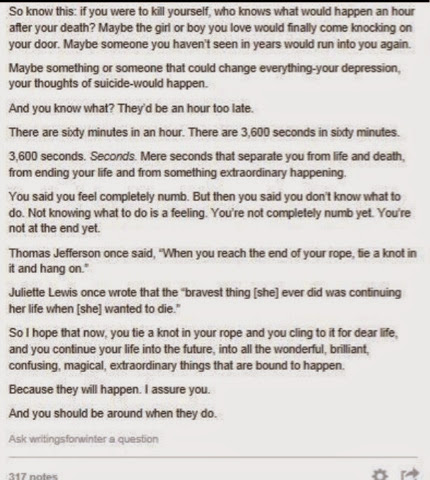
Anyway, searching the Semi-Colon Project, I saw a Tumblr post today that was absolutely stunning. 


"3,600 seconds. SECONDS. Mere seconds that separate you from life and death, from ending your life and from something extraordinary happening."

It's your story. Don't end it.

Monday, September 8, 2014

Everyone's Battle Is Different

I am a successful, contributing member of society, approaching thirty years of age. But there was actually a time in my life when I couldn't see myself living past 20. I remember remarking to myself on my 21st birthday that I'd made it farther than I ever thought and wondering how much longer I could go on. By then, a lot in my life had changed for the better. Things were good and I still had these terrible thoughts in my head. Since then, I finished college. I studied writing, an outlet for my passion and creativity, as well as a source of therapy. Since then, I found a loving, supportive man who loves me not despite all the darkness inside of me but because of it — and then I proposed to him and we got married. Since then, I've moved out of that house that reminded me of such a bad time in my life, and out of that town that held so many memories of people I'd rather forget, where everywhere I turned was a ghost of my past. I made a career with the same company I joined when I was 16 years old, moving my way up the corporate restaurant ladder. Oh, and I still occasionally do that thing I got my degree in.

How did I get here? as the Talking Heads would ask.

A friend told me today, "I'm proud of you for overcoming everything you've gone through in your life." I love her and I am truly fortunate to have people like her in my life who know what depression can do to people and who understand that everyone has a struggle. But I don't feel strong or brave. I look at people who overcome cancer and I think they are strong. I look at people who overcome sexual assault and I think they are strong. I look at soldiers to live with PTSD and I think they are strong. Those people have overcome. Those people have gone through worlds more that I have. For me to sit here and talk about my depression as if I've been through something traumatic is just pathetic. It's whiny bullshit, isn't it?

There's always a bigger fish. There will always be people with bigger problems, more righteous anger, or more serious issues. I can't cry because that shows weakness. If I talk about my problems, I'm asking for pity. If someone notices my scars, I cut myself for attention. I don't want any of these things. I would rather slink into a dark corner and die alone. How do I dare talk about my problems when so many people are going through or have overcome so much more than I have? 


That's the problem with the mental health stigma: that feeling of guilt and shame that accompanies any conversation regarding ones own problems. But everyone's battle is different. Someone out there is going through the same things I did. The struggle of the middle-class white kid stuck in a small town with demons in her head telling her she'll never be good enough, but knowing that it could be a hell of a lot worse, and knowing that doesn't make her feel a damn bit better. I have to keep reminding myself that this is why I am writing this: for her.

I'm still trying to figure out how exactly I made it this far. Identifying the tipping point isn't easy. I didn't just wake up one day and regain control of my life. There were baby steps that I took to get there. Positive affirmation was the biggest factor. But it was a journey worth writing about, so I will gather my thoughts on it and compose something at a later date. 

For now, I'll leave you with a final thought. It's National Suicide Prevention Week. There are people out there in the world who see suicide at such a foreign idea. They wonder how anyone could ever think that it is a reasonable solution to their problems. (It's not.) I hope those people recognize how fortunate they are and attempt to reserve their judgments. I have a wonderful life and I know that people would never guess it, but there are still days that I wish I wasn't alive. And considering the astounding 350 million people around the globe that have depression, if you aren't one of them, I guarantee there are friends and family of yours who have the same dark thoughts come creeping into their minds. So what can you do to help? Show them you care. Listen when they talk. Call them up or send a message. Ask what's wrong when they seem upset. Give them time to answer and don't be surprised if they have trouble articulating it. Don't pretend to know how they feel and don't make it about you. Just be there. And let them know how important they are to you. 

And if you are one of those 350 million? Talk about it! The only way we can help each other understand how common mental health issues are is to start talking about our own battles. Tell people what it's like to live an hour in your head. Speak out (with compassion) when you hear someone saying they don't get it and help them understand. And catch yourself when you start to judge someone you deem "crazier" than you. 

Finally, I know calling hotlines is weird and scary, but seriously, if you are at the end of your rope, if your situation has become so desperate that suicide is your last resort, I'm begging you to please at least call these folks first: National Suicide Prevention Lifeline — 1-800-273-8255.

Tuesday, August 12, 2014

I have scars, but I. Am. Alive.

I first cut myself when I was 15 years old. I remember the day very well because it was Valentine's Day and I was sitting on a stranger's house in a trailer park while my Loser Boyfriend got stoned. The room was filled with smoke and their eyes were so chinked that no one noticed when I found some random person's pocketknife and dragged it across my wrist. I could think of a thousand more romantic ways to spend such a holiday with the boy to whom I'd given my virginity just a month prior. Depressing, yes. But symptomatic?

Though that was the first time I had cut myself, it certainly wasn't the first time I'd felt so empty inside. I lived in a small ranch-style house with a big backyard for the first 5 years of my life. I have very few memories of that house, but one that stands out is this: I'm sitting on the edge of the patio watching as my brother plays with a couple other boys, our neighbors. I don't mind being alone, I actually prefer it. But I just wish I didn't feel so lonely.

There is a voice inside my head and it is my enemy. It tells me that I'm not good enough. I'm not smart enough. I'm not pretty enough. And more than anything, I am alone. It's a dirty fucking liar. That voice has been my constant companion for as long as I can remember.

Sitting in the smoke-filled trailer, I told myself, "No one will ever love you," as I dragged the knife across my arm. It had little to do with my Loser Boyfriend and everything to do with myself, my own self-worth. I didn't love me.

I soon found that razor-blades worked better than pocketknives. They made precise little slits into my flesh, nearly as thin as a paper cut. We had a box-cutter in the garage and the little razors that come inside them were perfect. I nearly always cut on my forearm. I would fashion them to look like scratches and when people asked, I'd tell them my cat did it. I'd never owned a cat. When too many people started questioning me, and one or two accused me of doing it for attention, I started wearing long-sleeves all the time, even in summer. I remember bleeding through my shirt in the dead heat of summer at the beginning of my sophomore year of high school and screaming in my head, "Why hasn't anyone noticed?!" I desperately wanted someone to look me in the eye and say, "I know you're going through hell in your own mind. I'm here for you." Or maybe, "You are not alone. I've been there. It gets better."

Pause; but keep going. #semicolonproject


The blood gave me a release. I had all this pain inside of me and I couldn't comprehend it. No one could see it, not even me. If I can't see it, is it even real? Having something to look at, something to see and say, "This. This is what ails me. This is my suffering." I could count them. Sometimes I would name them to myself, a reminder that it's not all in my head. "This one is for when I missed that pop fly in the outfield, this one is for not doing the dishes right and making Mom yell at me at 6am, this one is for when I went ahead with him even though I didn't really want to." It wasn't just that voice in my head making things up. There were actual instances of my numerous failures and shortcomings. I wasn't simply wallowing in my misery.

I think the worst it got was when I brought a razor blade to school with me because I didn't think I could make it through the day without either having a panic attack or cutting myself. I don't remember why I was particularly anxious that day, but I just knew I couldn't make it through without it. I tucked the blade in my sock and felt it rub my ankle all day. Under my desk, I crossed my ankle over my leg, wielded the razor, and made small slices in the flesh of my leg.

My best friends finally spoke up. What had taken them so long? I wondered. "You're scaring me," Shelby told me with tears in her eyes. "I don't want you to hurt yourself. I love you. Please stop. Please, for me if not for yourself." I choked up and nodded, grateful that someone in my life cared. Cared enough to cry over me hurting myself. And she didn't even know about my thoughts of suicide (pills, maybe?) or my frequent wish that I'd never been born.

My Loser Boyfriend finally said something too. He told me he'd break up with me if I cut myself again. That only made me feel guilty about it, which made me hate myself even more. And the hatred made me want to cut more and when I cut, I knew I was disappointing my friends and my boyfriend. Such is the vicious nature of the cycle. Finally, he tried a different approach. He convinced me to tell my parents, to try to get help. Recognizing the loop I was stuck in, I agreed.

My dad was away on a hunting trip when I decided to tell my mother. Maybe she was having a bad night, or maybe I picked the wrong time to unload on her, without my dad there to support her. Whatever the reason, she did not take the news well. My Loser Boyfriend sat quietly by my side as I cried and confessed to my mother that I had been cutting myself and that I thought I needed to see a therapist. I wasn't expecting a tearful embrace or any sort of consoling. But I also was not expecting the cold, uncompassionate response I received. "Why are you telling me this?" she asked. "Why now? Of course you want to talk to someone. Everyone in the world would love to have a therapist to listen to all of their problems. We can't afford that." I cried and begged her to understand. It wasn't just normal teenage angst, I insisted. I lifted my sleeves and showed her the cuts. "I will not walk on eggshells because you feel sad," she declared, slamming the book on the conversation. I was devastated.

I realized then that it would be up to me to pull myself out of this. Luckily, I grew up with the world at my fingertips, as long as I had the patience to wait for the dial-up modem. The internet has been a constant resource, offering stories of people who had been there, who traveled down that dark tunnel with nary a light at the end, and who had made it out the other side. It is my hope now that I can do the same for others searching for hope.

You are not alone. It gets better.

I have scars, but I. Am. Alive.

More to come...